

Sinéad O’Connor And The Irish Way Of Death
Sing me a song of a lass that is gone

The Irish handle death both very well and sometimes terribly poorly.
It’s likely the world will see the Irish way of death play out following the passing of talented and troubled singer Sinéad O’Connor.
For better or worse, O’Connor died in London.
No cause of death was given in O’Connor’s case, which is not unusual in Irish families and in the Irish press.
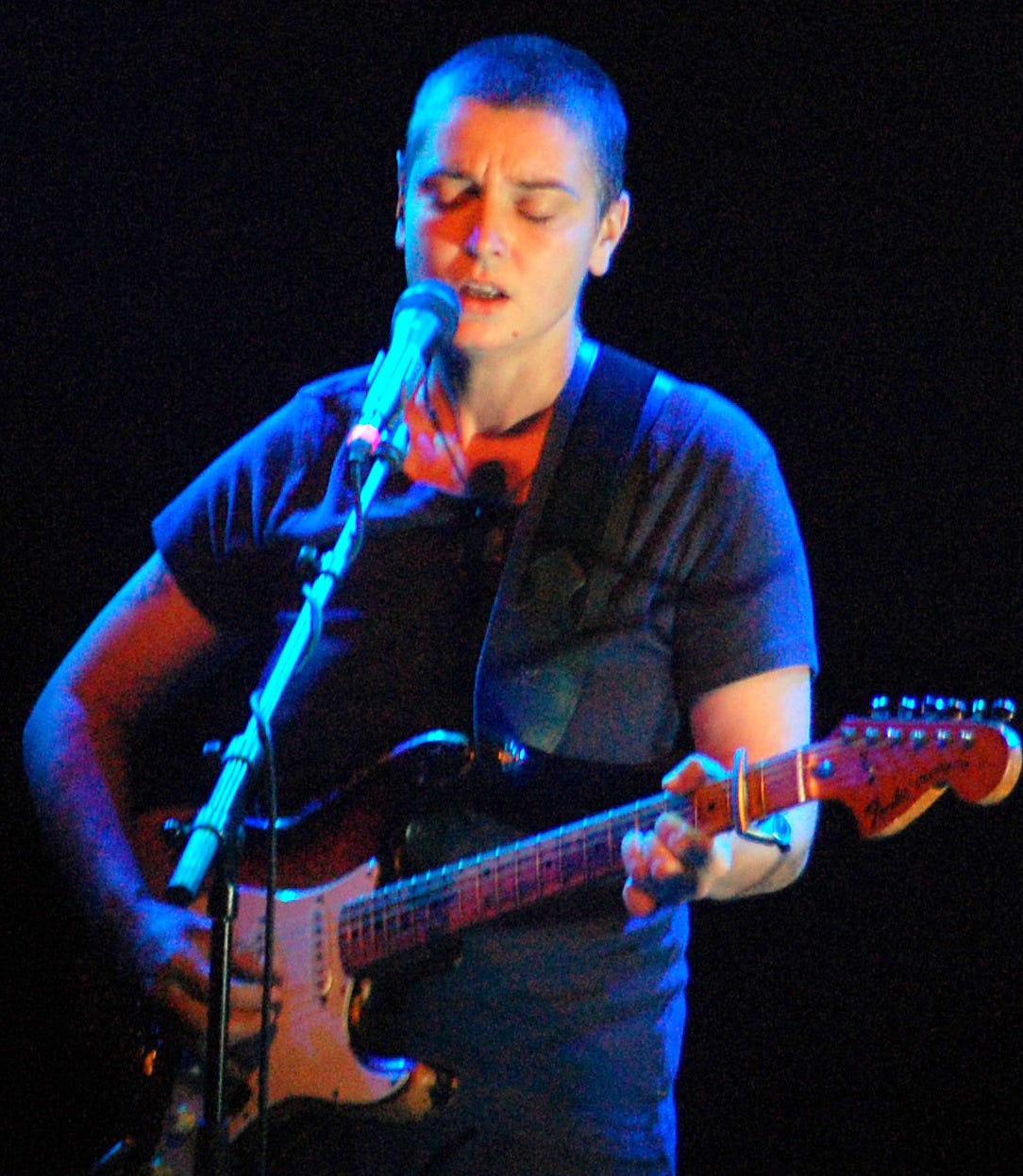
O'Connor at "The Music in My Head" on 13 June 2008 in The Hague. Credit: Creative Common/Wikipedia by Leah Pritchard from Den Haag, Netherlands
From what I’ve seen on my visits to Ireland, unless someone dies in an obvious or public sort of way, the cause of death is frequently not mentioned in obituaries or new accounts. Those close to the decreased usually know, but the cause of death is often kept private, hidden from the wider world.
But no secrets are kept for long from the English tabloids.
Eventually a tabloid reporter will worm or bribe his or her way into getting access to autopsy records or getting a mortuary worker to talk. Then there will be a second tide of salacious news to milk a few more bits of sensations from the singer’s passing.
We are already seeing that happen a day after her death was announced, with stories reporting the tidbit that the English authorities are saying her death was “not suspicious.”
It’s no secret Sinéad O’Connor had a troubled life.
But her she wore her personal, emotional troubles both like a suit of armor and a very public vulnerability. I view this apparent contradiction as being a very Irish thing.
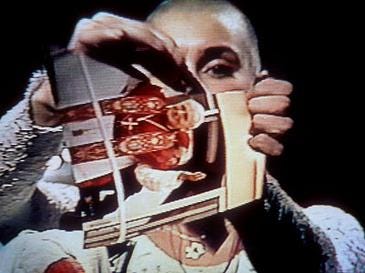
O'Connor protesting the cover-up of Catholic Church sexual abuse cases tore a picture of Pope John Paul II into pieces on live on Saturday Night Live in 1992
Like many things Irish and in Ireland, there was much unsaid and said. O’Connor herself eventually addressed some of her issues on her own terms in her 2021 memoir Rememberings.
The Irish live side-by-side with death and death is intertwined with life. Death and ancestors gone are all around in Ireland.
The landscape is populated with massive ancient passage tombs and wedge graves created by a now gone culture. Left behind are monuments like Newgrange in County Meath and Queen Maeve's Cairn perched high atop Knocknarea in County Sligo, overlooking a landscape populated hundreds of other ancient graves.
Then there are the hundreds of medieval graveyards like the Hill of Faughart or Monasterboice, both in County Louth, that contain the graves of people who died and 1,000 years ago and those who may have died last week.

Recent grave of a beloved young man who loved football in the 1,000-year-old Monasterboice cemetery in County Louth.
This is a nation that in the past 200 years witnessed more than million people die of starvation, while another nation, England, fed upon its crops. This is a nation with a population of less than 5 million (a figure only recently reached) that in the 20th century saw hundreds die in hideous ways in a war of independence, a civil war and a long-running sectarian conflict known as The Troubles.
Irish funerals and wakes are famous affairs, both sad and life affirming at the same time. They are social events that can bring far-flung families and entire communities together – social events not to be missed like weddings, christenings. There is weeping and laughter, sometimes nasty gossip among the adults and joyous games among the young. Even in recent times there have been fights and violence at Irish funerals.
Like all funerals, these event are not for the dead, they are for the living, to help the living cope with a death whether long-anticipated or sudden and shocking.
The Irish value remembering their ancestors, sometimes ancestors they never knew but have attain a status of reverence.
A common feature on Irish radio is the reading of remembrances. An announcer will solemnly announce the name of deceased person say something like “gone these 15 year now” and bell will tool for that soul.
These are very popular shows, tuned into by both young and old, but perhaps more closely regarded by those who are closer to the time when it may be their name being read.
Whatever ghoulish gossip will come sliming out of the UK press regarding the nature of O’Connor’s death, it’s likely many in Ireland, even those who may not have liked or agreed with her and her actions, will likely pause, if only to honor her talent and her status as kind of troubled warrior queen. The likes of O’Connor are what have made the Irish and Ireland great, a small nation with an outsize personality and influence on the world.
There will be sadness. There will be a party. There will be an Irish wake.
Some will handle it well, honoring O’Connor’s memory. Some will chew sour grapes, handling it poorly, putting her down, only making themselves look bad.
Although it is actually about Scotland, country the Irish share some kinship with, O’Connor’s 2023 rendition of the Sky Boat Song (with lyrics adapted from Robert Louis Stevenson’s 1892 poem "Sing Me a Song of a Lad That Is Gone" with "lass" substituted for “lad” to fit the story), is appropriate parting tune for O’Connor.
[Chorus:] Sing me a song of a lass that is gone,
Say, could that lass be I?
Merry of soul she sailed on a day
Over the sea to Skye.
1. Mull was astern, Rum on the port,
Eigg on the starboard bow;
Glory of youth glowed in her soul;
Where is that glory now?
[Chorus]
2. Give me again all that was there,
Give me the sun that shone!
Give me the eyes, give me the soul,
Give me the lass that's gone!
[Chorus]
3. Billow and breeze, islands and seas,
Mountains of rain and sun,
All that was good, all that was fair,
All that was me is gone.
That's a gorgeous song, and when I heard her version on OUTLANDER, I cried. I'm of Scottish/Irish heritage, and I feel like there is an inherited melancholy that I both love and find weighty. But I love people who have it.
I know. When I heard she was going to record the Outlander theme I thought that was perfect. And then I heard it and it was even better than I imagined. Sinead was a person who the media created this false image of her, but she manged to chart her own way anyway and worked through what was obviously crushing depression that eventually overtook her. I've not been to Scotland, but I'm a dual US/Irish citizen (my grandparents were immigrants) and I've spent some time in Ireland. In Ireland the ancestors, both ancient and recent, are always close at hand. I've spent a lot of time cemeteries and in 5,000-year-old ritual landscapes and you quickly understand the outlook. Scotland is supposed to be much the same way and of course there's something of a kinship with the Irish (for better and worse). Enjoy Scotland. I hope you're going to write about it.